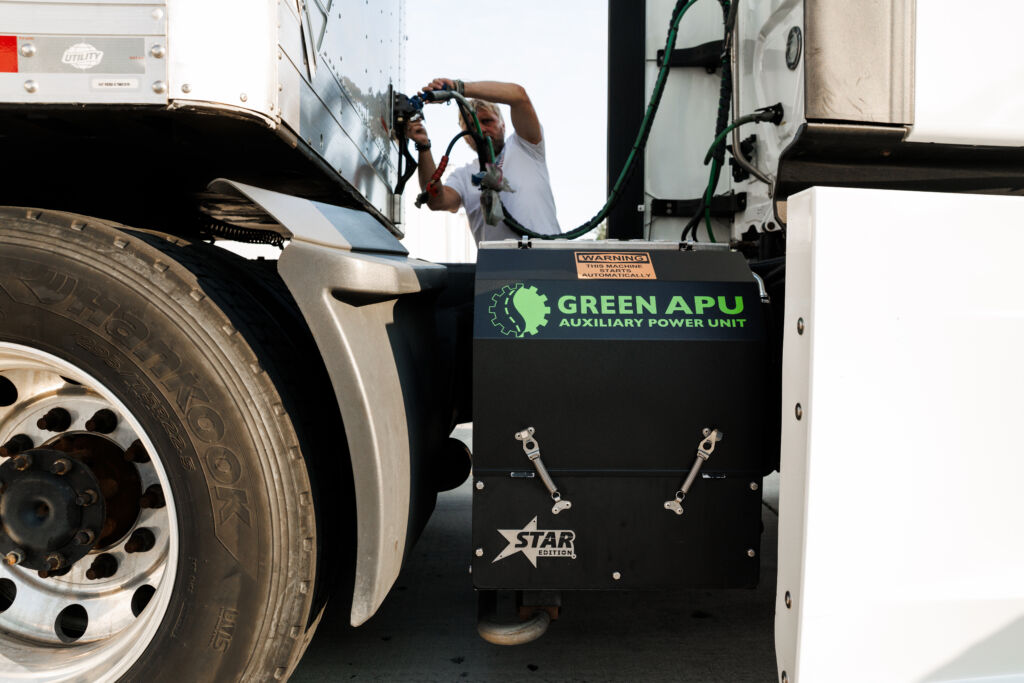
Short answer: for most owner-operators who put in real miles and sleep in the truck, yes. An APU pays for itself, usually faster than you would expect, and after that it keeps money in your pocket every night you would otherwise be idling.
But “it depends” earns its keep here, because not every truck and not every driver idles the same. So let’s do it the way truckers actually talk about money. Lay out the numbers, show the math, and let you decide whether one fits your operation. No pressure.
What an APU actually does for you
An APU (auxiliary power unit) is a small engine that runs your heat, your air conditioning, and your cab power overnight without idling your main engine. You shut the truck down, switch the APU on from your sleeper, and you sleep without burning diesel to run a big engine just to stay warm.
A Green APU puts out 26,000 BTU of heating and cooling, some of the highest output in the industry. That is not a “takes the edge off” number. That is keep-the-bunk-comfortable in a Minnesota January or a Phoenix July number. It runs on a three-cylinder Kubota diesel, the one part of the unit not built in the USA, and we say that plainly because it is a proven engine truckers already trust. Everything else is designed and assembled in the USA.
If you are brand new to these units, start with our complete guide to semi-truck APUs, then come back here for the part that decides it: whether one is worth it on your truck.
The real question: does it pay for itself?
This is the whole ballgame. An APU is not a comfort toy. It is a fuel-savings machine that happens to keep you comfortable. Here is the math, and you can adjust every number to your own truck.
A semi at idle burns about a gallon of diesel an hour. A Green APU does the same job (heat, cool, and power the cab) on about a quarter of that. So run a clean example:
- Idle hours per night: about 10, a normal overnight or reset
- A full-time year over the road: roughly 3,200 idle hours
Idling your main engine: 3,200 hours times about a gallon an hour is about 3,200 gallons. At $3.75 diesel, that is roughly $12,000 a year burned at the curb.
Running a Green APU instead: 3,200 hours times about a quarter gallon an hour is about 800 gallons. At $3.75, that is roughly $3,000.
That is about 2,400 gallons and roughly $9,000 a year, and you have fueled lately, so you know $3.75 is on the friendly side. Move the idle hours, the nights, and your local fuel price and the number moves with them, but the gap between a gallon an hour and a quarter gallon an hour is the engine of your savings no matter how you slice it. Want it dialed in to your truck? Run your own numbers on our savings calculator. It takes about a minute.
What the fuel receipt doesn’t show
The pump is only part of it.
Every hour you idle your main engine is an hour of wear, oil dilution, and, on a modern emissions truck, aftertreatment abuse you pay for later. Idle hours are what kill DPFs and trigger parked regens and sensor failures. Run the APU overnight instead and you stretch the life of the most expensive parts of your truck, money that never shows up on a fuel receipt but absolutely shows up at overhaul and cleaning time.
Then there is the law. A lot of states and cities have anti-idling rules, and the fines are not small. An APU keeps you legal and comfortable where letting the truck run is not an option. One ticket avoided is a chunk of payback right there.
If you want the full purchase, install, and payback picture in one place, we broke it all down in our honest cost breakdown.
So how fast does it pay off, and for whom?
For grounding: our Star Edition starts at $14,999 MSRP with installation included. Put the fuel savings against that, add the engine and aftertreatment wear that idling piles on, and a full-time owner-operator who sleeps in the truck typically has it paid off in about a year, call it 14 months.
Idle less and it takes longer, and that is the honest part. A regional or part-time driver who is home more nights saves proportionally less, so the payback stretches out. But even at half those hours, you are paid back well inside the 2-year unlimited-hours warranty. After that, the savings just keep landing every year you own the truck. That is the part people miss: the APU stops being a purchase and starts paying you back. And if paying cash up front is not the plan, financing can spread it across payments that often run smaller than what you are already burning in idle fuel.
“Worth it” also depends on the APU you buy
Here is where drivers get burned. They buy an APU, then find out the parts come from one dealer network, the support line routes overseas, and a small part turns into a three-day breakdown in the middle of nowhere. That is not worth it. That is a liability.
This is exactly why Green APU exists. Founder Art Gruszka ran a fleet of about 200 trucks out of Lemont, Illinois, got tired of proprietary lock-in and support that left his drivers stranded, and built the APU he wished someone would sell him. “For Truckers, By Truckers” is not a slogan on a hat. It is literally why the company exists.
So when you decide whether an APU is worth it, look at:
- Parts you can actually get. A Green APU is built on standard automotive parts. Belts, filters, sensors, the service items are on the shelf at any automotive parts store in the country, and any diesel shop can do the work. No dealer-only ecosystem, no waiting three states away.
- Support that picks up. Lifetime 24/7 US-based tech support, including remote, on-the-road diagnostics. Call at 2 a.m. from anywhere and a real person here in America walks you through it. That is the difference between a bad night and a blown weekend.
- A warranty that means it. Two years, unlimited hours. Not “two years or X hours, whichever comes first.” Run it as hard as your work demands.
- Simple maintenance. A service every 1,000 hours on standard components, with the serpentine belt added at the 3,000-hour service. Straightforward, the way an engine should be.
A cheap APU you cannot service and cannot get support for is not a deal. A well-built one with real parts access and lifetime support is the one that is actually worth it.
What about an electric APU?
If you are weighing a battery-electric unit instead, the honest answer is that it depends on how you run. Electric units are quiet and burn nothing while parked, but they typically put out less cooling (roughly 7,500 to 15,000 BTU), give you a fixed runtime (often 8 to 14 hours before the truck has to run again), still lean on a fuel-fired heater for real winter warmth, and want you to pre-cool the cab with the main engine first. For a driver who lives in the sleeper for weeks, that math usually favors diesel. We laid the whole thing out, fairly, in our electric APU vs diesel APU comparison.
So, are APUs worth it for your operation?
If you idle regularly, run real miles, and plan to keep your truck a while: yes. The fuel savings alone typically pay it off inside the warranty, you save your main engine and aftertreatment, you stay legal under anti-idle laws, and you sleep in a comfortable cab every night.
The only way an APU is not worth it is if you buy the wrong one: proprietary parts, no support, a warranty full of asterisks. Buy one that is built right and it is one of the best returns on a dollar anywhere on the truck.
Run your own numbers in about a minute on our savings calculator, then call (877) 751-0686, where a person picks up 365 days a year, or find a location near you for an installed quote on your truck.
Frequently Asked Questions
How long does it take for an APU to pay for itself?
For a full-time owner-operator who sleeps in the truck, about a year, call it 14 months, counting fuel savings plus the engine and aftertreatment wear that idling piles on. Idling your main engine burns about a gallon an hour, while a Green APU uses about a quarter gallon an hour to heat, cool, and power the cab. The more you idle, the faster it pays off. Regional and part-time drivers take proportionally longer, but still land inside the 2-year warranty. Run your exact numbers on our savings calculator.
How much fuel does an APU save compared to idling?
A Green APU uses about a quarter gallon an hour versus roughly a gallon an hour to idle your main engine, a difference of about three quarters of a gallon every hour. For a truck idling around 3,200 hours a year, that is roughly 2,400 gallons saved, about $9,000 at $3.75 diesel, depending on your idle hours and local fuel prices.
Are APUs worth it for owner-operators?
Yes, for most owner-operators who idle regularly and run real miles. An APU typically pays for itself in fuel savings inside the 2-year warranty, reduces wear on your main engine and aftertreatment, and keeps you compliant with anti-idling laws, all while keeping your cab comfortable. The key is buying a well-built APU with accessible parts and real support.
Does an APU help with anti-idling laws?
Yes. Many states and cities have anti-idling regulations with real fines. An APU lets you keep your cab heated, cooled, and powered overnight without idling your main engine, keeping you compliant and comfortable where letting the truck run is not allowed.
What should I look for when buying an APU?
Look for accessible parts (a Green APU uses standard automotive parts from any automotive parts store, no proprietary lock-in), real support (lifetime 24/7 US-based tech support with on-the-road diagnostics), a strong warranty (two years, unlimited hours), high output (26,000 BTU), and simple maintenance (a service every 1,000 hours).