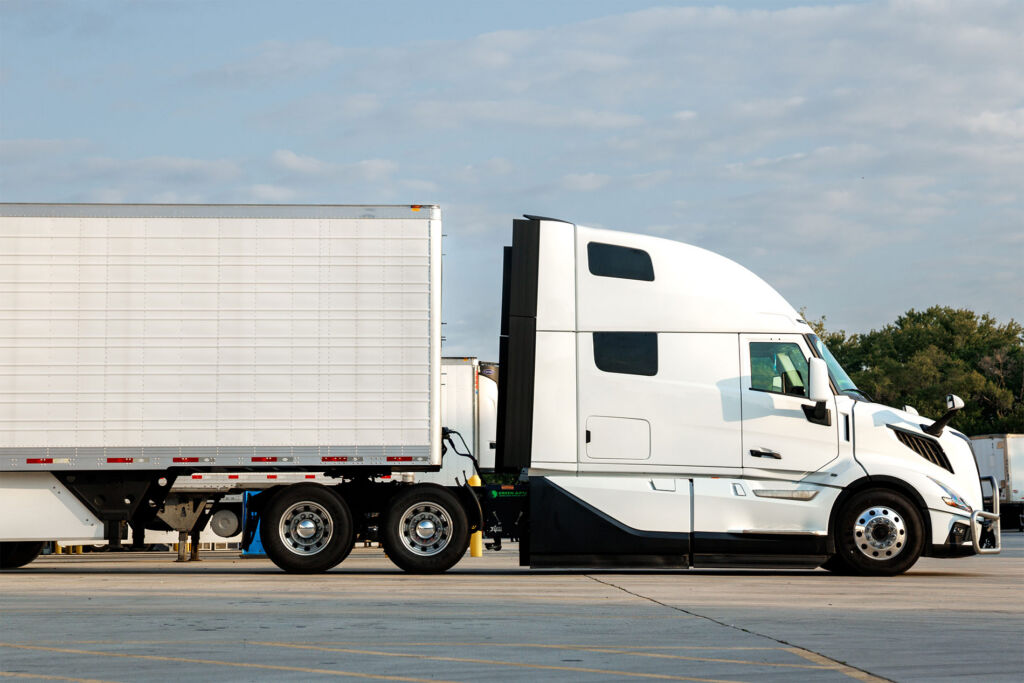
Every mile you drive is money earned, and every hour your truck sits idling is money burned. A semi-truck APU is the piece of equipment that breaks that trade-off. It keeps your cab warm in January and cool in August, runs your electronics, and keeps your batteries charged, all without idling the big engine to do it. This guide covers what an APU is, why drivers install one, what it costs, how diesel and electric compare, and what to look for so you buy a unit that any shop can keep running for years.
What a semi-truck APU actually is
An Auxiliary Power Unit, or APU, is a small, self-contained power source for a semi truck that does the work your main engine used to do while parked. Instead of idling a big diesel all night to run the heat, the air conditioning, and the outlets in your sleeper, the APU handles all of it on a fraction of the fuel.
The idea isn’t new or unproven. Aircraft have used auxiliary power units for decades to run onboard systems and conserve the main engines before takeoff. The same logic applies to a truck: let a small dedicated unit carry the load so the big engine can rest.
There are two kinds. A diesel APU is a small engine, a compressor, and an alternator that runs on fuel from your own tank. An electric APU is a battery bank, an inverter, and an electric air conditioner that charges while you drive. Both do the same basic job. They just do it differently, and we’ll get to which fits which kind of driver below.
What a good truck APU does have in common with the best equipment on your truck: it makes the overnight simple. Shut the main engine down, switch the unit on from the controller in your sleeper, set your temperature, and that’s it. Climate control runs all night, the cab stays comfortable, and you sleep.
Why drivers install an APU for their trucks
Comfort that runs itself. After a long drive, you shouldn’t have to choose between a comfortable bunk and a running engine. An APU keeps the sleeper at the temperature you set, quietly, all night. It cools the cab in summer heat and heats it through a hard winter, and on a cold morning it can preheat the engine coolant so the truck starts even when the temperature drops below freezing.
The fuel math. This is the reason most drivers run the numbers and then buy. A semi at idle burns about a gallon of diesel an hour. A diesel APU does the same job on about a quarter gallon an hour, which is roughly three quarters of a gallon saved for every hour you would have idled. Here’s a full-time driver’s night and year, side by side:
Using $3.75 diesel, that’s roughly 2,400 gallons and about $9,000 saved in a year. Your idle hours and your local fuel price move the number, so run it for your own truck.
Run your numbers on the savings calculator
Less wear, fewer shop visits. Idle hours are hard hours. A truck can pile up a couple thousand idle hours a year, and every one is wear on the main engine and, on a modern emissions truck, punishment for the aftertreatment system. Parked regens, DPF cleanings, and sensor failures are what idle hours do to a newer truck, and that’s real money on top of the fuel. Take the idling away and the engine lasts longer and spends less time in the service shop.
Staying legal. Anti-idling laws have spread across states and cities, and crackdowns to protect air quality keep getting more common. An idling ticket is a cost you never planned for. An APU lets you run your heat, your air, and your power while the main engine stays off, which keeps you comfortable and out of trouble in no-idle zones. Before you buy, it’s worth thinking hard about whether an APU is worth it for your operation.
Backup when you need it. An APU is also insurance. If the main engine ever quits, the unit can keep power and climate running in the cab while you sort out the problem, instead of leaving you stranded in the cold or the heat.
What a semi-truck APU costs
Plan on somewhere between $12,000 and $17,000+ installed for a new diesel unit from an established brand, and loaded setups can run past that. The unit itself runs in the mid-teens, and installation goes on top of that. Our Star Edition starts at $14,999 MSRP with installation included, which lands toward the friendly end of that range.
If you see an article quoting $8,000 or $9,000, check the date on it. That was real pricing years ago. Today a number that low is usually a used take-off with no warranty or an import with nobody around to service it, and both of those turn out to be the expensive option. Diesel climbed right alongside the units, so the savings math between idling and an APU hasn’t really moved.
The sticker is only about a third of the story, though. What separates APUs over the years you own them is parts, service, and warranty. For the whole breakdown, including install and payback, see what a semi-truck APU costs.
Diesel or electric
Electric APUs look good on paper: no second engine, nothing burning while you’re parked, and near silence. For a driver who’s home most nights in a mild climate, that can be plenty.
The catch is runtime. An electric unit is a battery bank, and the battery is the fuel tank. Most electric systems deliver somewhere between 8 and 14 hours of cooling on a full charge, less in brutal heat, with cooling output typically in the 7,500 to 15,000 BTU range. When the batteries run down, the truck has to run to recharge them, which is the exact thing you bought an APU to avoid. Most electric units also lean on a fuel-fired bunk heater for real winter heat, so “electric” mostly means electric cooling. And manufacturers themselves recommend pre-cooling the cab with the main engine before you shut down, because a battery unit holds a temperature better than it makes one.
A diesel APU measures its runtime in fuel, not charge. It runs as long as there’s diesel in the tank, whether that’s one night or four, and it puts out steady heat and cooling either way. The more nights you live in the truck, the more the math tilts diesel. We lay out the whole thing in our electric APU vs diesel APU comparison.
What to look for in any APU
Whatever brand you buy, these are the questions that decide whether you’re still happy with it in year four.
Parts availability. This is the big one. Most APUs are built on proprietary components, which means the manufacturer is the only source. When something fails, you pay what they ask and you wait as long as their supply chain makes you wait. Ask straight out: are the service parts proprietary, or standard automotive? The answer doesn’t matter the day you buy. It matters every year after.
Warranty terms. Read two things before you sign. First, the hours cap. A unit that runs hard piles up hours fast, and a lot of warranties quietly expire at an hours number long before the calendar date does. Second, what’s actually covered. Some brands split coverage into tiers, one term for this part and a shorter one for that part, so the piece that fails on you may be the one with the short coverage. Ask for the full breakdown and read it.
Service network. Who fixes it where you actually run? A thin dealer network is fine until you break down 800 miles from the nearest one. Ask what happens then.
Build quality and output. You want enough heating and cooling for your sleeper in real summers and real winters, and a build that holds up to daily use. A cheap unit that’s expensive to keep alive costs more than a fair-priced one any shop can fix. Every time.
The Green APU difference
We build a diesel APU designed around exactly those questions.
Standard automotive parts. A Green APU runs on a Kubota three-cylinder diesel engine and standard automotive components. Belts, filters, and sensors are sitting on the shelf at any automotive parts store in the country, and any diesel shop can do the work. You’re never stuck waiting on a proprietary supply chain, so repairs cost less and get done faster. That’s a maintenance story most APUs, diesel or electric, can’t tell.
Simple maintenance. The unit runs 1,000 hours between preventive maintenance services, on parts any diesel shop already stocks. The 3,000-hour service adds a serpentine belt. That’s the whole rhythm.
A warranty you can remember. Two years, unlimited hours. Run it as hard as your work demands. After that, lifetime 24/7 US-based tech support, and a person answers the phone. We’re a little proud of that one.
Output that carries a big sleeper. 26,000 BTU of heating and cooling, some of the highest output in the industry, and it charges your truck batteries while it runs instead of draining them.
Built in America, built to last. Green APU started in 2011 when Art Gruszka, a fleet owner running about 200 trucks, got tired of APUs that broke and couldn’t be fixed. The unit we build is the one he wished somebody would sell him: an all-aluminum housing that doesn’t rust, a single self-adjusting serpentine belt instead of a tangle of V-belts, and every unit designed, assembled, and quality-checked at our own facility in Lemont, Illinois. High-quality, American-made equipment, because that’s what we’d want on our own trucks.
FAQ
What is an APU on a semi truck?
An APU, or Auxiliary Power Unit, is a small self-contained unit that powers your heat, air conditioning, and electronics while you’re parked, so you don’t have to idle the main engine to stay comfortable. A diesel APU runs on fuel from your own tank, and an electric one runs off a battery bank. Either way, you switch it on from your sleeper after you shut the engine down, set your temperature, and you’re done.
How much fuel does a truck APU save?
Idling burns about a gallon of diesel an hour, and a diesel APU does the same job on about a quarter gallon, so you save roughly three quarters of a gallon for every hour you’d have idled. A driver idling around 10 hours a night, about 3,200 hours a year, saves roughly 2,400 gallons, which is around $9,000 at $3.75 diesel. Run your own numbers on our savings calculator.
How much does a semi-truck APU cost?
Figure $12,000 to $17,000+ installed for a new unit from an established brand. Our Star Edition is $14,999 MSRP with install included. Articles quoting $8,000 to $10,000 are working off years-old pricing or a bare unit before anyone touches the truck, so compare all-in quotes.
How long does an APU take to pay for itself?
For a full-time driver who sleeps in the truck, usually about 14 months, counting fuel plus the engine and aftertreatment wear that idling piles on. Idle fewer hours and it takes longer, but payback still lands well inside the 2-year warranty.
Do I want a diesel or electric APU?
If you’re home most nights in a mild climate and value silence, an electric unit may serve you fine. If you’re over the road for weeks, take multi-day sits, and run real summers and winters, a diesel APU is the safer bet, because it runs as long as you have fuel instead of a fixed number of battery hours.
Can an APU keep my truck legal in no-idle zones?
Yes. An APU lets you run your heat, air, and power with the main engine off, which is what most anti-idling laws are after. That keeps you comfortable and helps you avoid idling tickets in the states and cities that enforce them.
The bottom line
For a truck that’s your home for weeks at a stretch, an APU is one of the few upgrades that pays you back in fuel, in engine life, and in a full night’s sleep. Call (877) 751-0686 any time, a person picks up 365 days a year, or find a dealer near you for an installed quote on your truck.
About Green APU
Green APU has built American-made auxiliary power units in Lemont, Illinois since 2011. The company was founded by Art Gruszka, a fleet owner running about 200 trucks who got tired of APUs that broke and could not be fixed, so he built the one he wished somebody would sell him.
The Star Edition is a diesel APU rated at 26,000 BTU, powered by a three-cylinder Kubota engine, and built on standard automotive parts so any diesel shop can service it. Preventive maintenance runs every 1,000 hours. Every unit carries a two-year unlimited-hour warranty and lifetime 24/7 technical support, answered by a person in the United States.
Designed and assembled in the USA. Sold and serviced through our Lemont, Illinois shop and a growing dealer network. For Truckers, By Truckers. Call (877) 751-0686 or visit greenapu.com.